AI curated news has rapidly become a dominant way people consume information, reshaping how headlines are selected, ranked, and delivered to audiences. From social media platforms to news aggregation apps, algorithms increasingly determine which stories users see first and which ones never appear at all. While AI curated news promises speed, efficiency, and relevance, it also raises serious editorial concerns about accuracy, balance, and public trust in journalism.
As audiences migrate away from traditional front pages toward algorithm-driven feeds, the influence of AI curated news continues to grow. News consumption is no longer guided primarily by editors applying journalistic judgment, but by automated systems optimized for engagement. This shift has prompted renewed debate about media ethics, especially as technology begins to shape public understanding of events at scale.
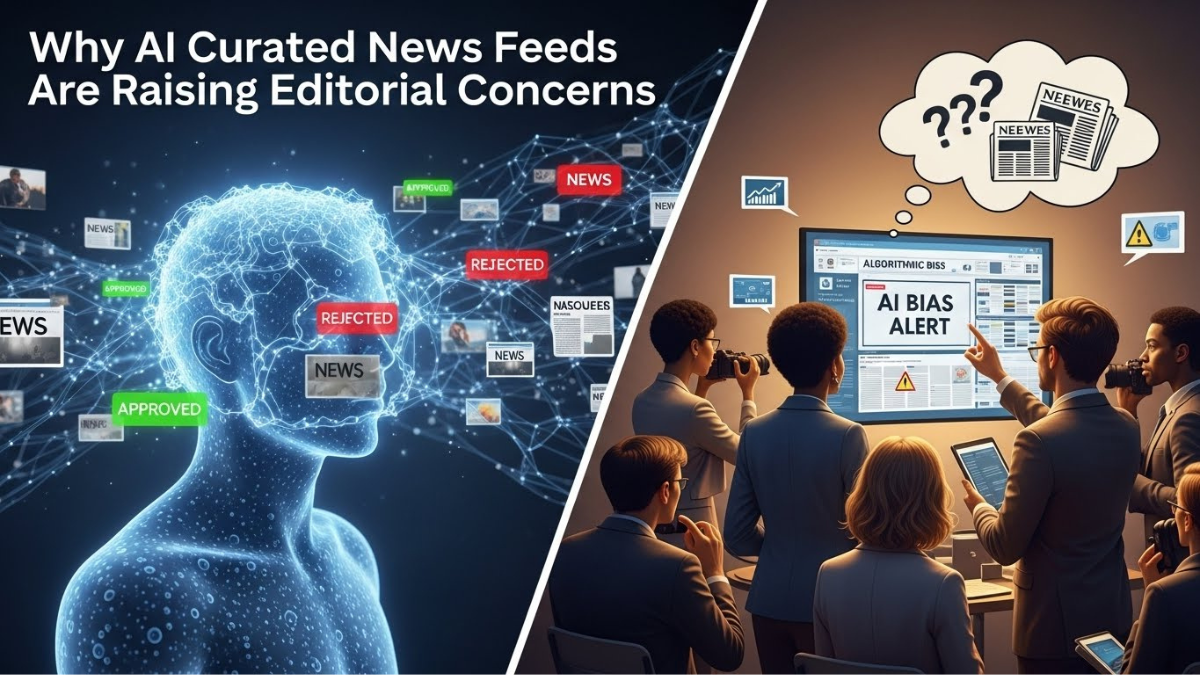
Personalization and the reshaping of news consumption
One of the strongest appeals of AI curated news is personalization, which tailors content to individual interests, reading habits, and past behavior. By analyzing clicks, reading time, and sharing patterns, algorithms create highly customized news feeds that feel relevant and convenient. This level of personalization increases user engagement and keeps audiences returning to platforms.
However, excessive personalization can narrow exposure to diverse viewpoints. When AI curated news prioritizes content aligned with existing preferences, users may miss important stories that fall outside their usual interests. Over time, this selective exposure reshapes how individuals understand complex issues, reinforcing existing beliefs rather than encouraging critical engagement. These effects raise concerns about the long-term impact of personalization on informed citizenship and democratic discourse.
Algorithm bias and its editorial consequences
A major concern surrounding AI curated news is algorithm bias, which can influence which stories gain visibility and which are suppressed. Algorithms are trained on historical data that may reflect social, political, or cultural biases. As a result, algorithm bias can unintentionally amplify certain narratives while marginalizing others, even without explicit human intent.
Unlike traditional editorial decisions, algorithm bias operates at scale and often without transparency. Audiences may not realize that their news feed is shaped by invisible rules prioritizing engagement metrics over editorial significance. This lack of accountability challenges core principles of media ethics, as responsibility for content selection becomes diffused between developers, platforms, and publishers. The rise of AI curated news therefore complicates how bias is identified and addressed in modern journalism.
Media ethics and the erosion of editorial accountability
The expansion of AI curated news raises fundamental questions about media ethics, particularly around accountability and responsibility. In traditional newsrooms, editors are accountable for decisions about accuracy, balance, and harm. With algorithm-driven curation, these decisions are embedded in code, making ethical oversight more complex.
When errors, misinformation, or harmful content spread through AI curated news, it can be difficult to determine who is responsible. Is it the platform, the publisher, or the algorithm itself? This ambiguity challenges established ethical frameworks within journalism. As media ethics struggle to keep pace with automation, there is growing concern that editorial values may be sidelined in favor of engagement-driven optimization.
Key editorial concerns linked to AI curated news include:
- Reduced transparency in content selection
- Risk of algorithm bias shaping public narratives
- Overreliance on personalization
- Weakened editorial accountability
- Ethical challenges for modern journalism
The table below compares traditional editorial curation with AI curated news models:
| Aspect | Traditional News Editing | AI Curated News |
|---|---|---|
| Content selection | Human editors | Automated algorithms |
| Bias control | Editorial oversight | Risk of algorithm bias |
| Personalization | Limited | High personalization |
| Media ethics | Clearly defined | Diffused responsibility |
| Transparency | Visible editorial standards | Often opaque systems |
Public trust, misinformation, and long-term risks
Public trust is a critical casualty in debates around AI curated news. When audiences encounter conflicting information or feel manipulated by opaque systems, confidence in news sources declines. Algorithm bias can contribute to misinformation by amplifying sensational or polarizing content that performs well on engagement metrics, regardless of accuracy.
Over time, reliance on AI curated news may weaken shared information spaces where citizens engage with common facts. Extreme personalization fragments audiences, making collective understanding more difficult. These trends pose serious challenges for media ethics, as journalism’s role in supporting informed societies becomes harder to fulfill within algorithm-driven ecosystems.
Conclusion
In conclusion, AI curated news is raising editorial concerns because it fundamentally alters how information is selected, prioritized, and consumed. While personalization enhances convenience, it also narrows exposure and intensifies algorithm bias. Combined with unresolved questions around media ethics and accountability, these issues highlight the need for greater transparency and human oversight. As AI continues to shape news consumption, balancing technological efficiency with editorial responsibility will be essential for preserving trust and integrity in modern journalism.
FAQs
What is AI curated news?
AI curated news refers to news feeds organized and ranked by algorithms rather than human editors.
Why is algorithm bias a concern in AI curated news?
Algorithm bias can amplify certain viewpoints while suppressing others, influencing public understanding without transparency.
How does personalization affect news consumption?
Personalization tailors content to user preferences but may limit exposure to diverse perspectives.
What are the media ethics challenges with AI curated news?
Media ethics challenges include accountability, transparency, and responsibility for algorithm-driven decisions.
Can AI curated news replace human editors?
AI curated news can support editors, but full replacement raises concerns about judgment, ethics, and public trust.
Click here to know more.